
The Eyes of the Skin
“Veo con ojos que sienten, siento con manos que ven.” Johann Wolfgang von Goethe.
Activar la memoria es el deseo que Louisa Holecz (Londres, 1971) anhela en la secuencia de dibujos, pinturas, fotografías y esculturas que presenta en la exposición titulada The Eyes of the Skin en la galería Carolina Rojo.
Louisa Holecz escribe:
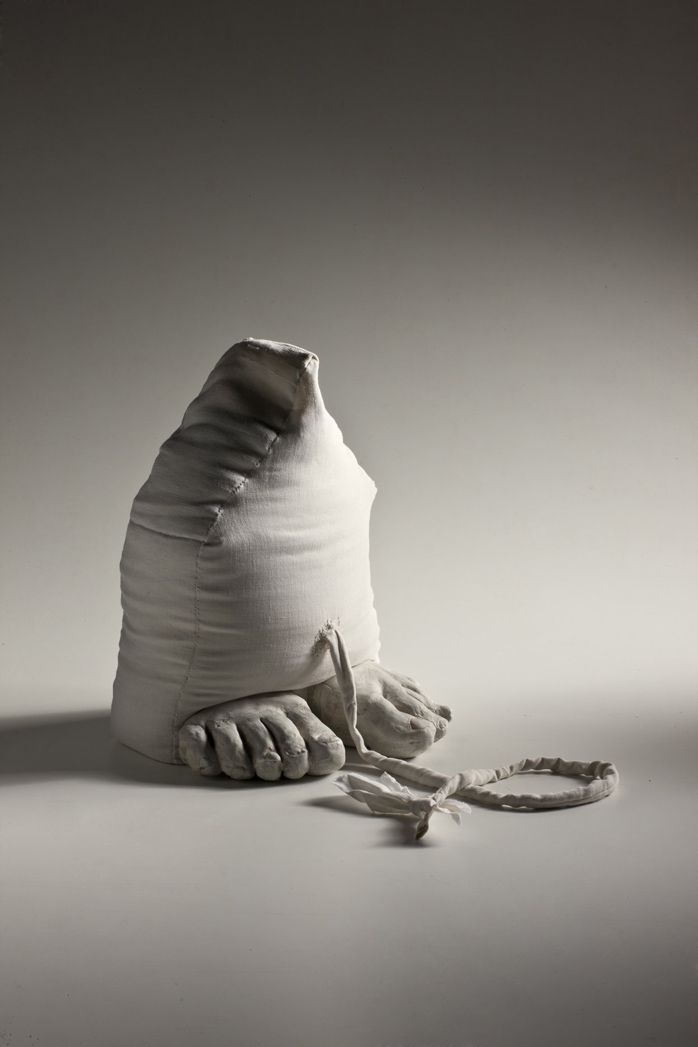
“Con una mirada retrospectiva ahora puedo comprender que la escultura cosida Home II (2013) era un autorretrato metafórico y, como tal, sirvió de estudio preparatorio para mi Autorretrato de 2014. Asimismo, la escultura Home I (2011) fue una representación simbólica inicial de mi madre antes de comenzar su retrato, Mãe (2014), un retrato de gran formato en pastel sobre lienzo. Todo este proceso es el resultado de la tarea autoimpuesta de dibujar y redibujar a mi madre, con el único propósito de poder recordar su rostro visualizándolo a voluntad.
Mãe me inspiró la pequeña escultura amuñecada Meerschaum Mother que modelé de memoria y posteriormente fijé en el cuerpo cosido y relleno de sepiolita. El tejido utilizado es un fragmento de una reliquia familiar de lino bordado; de joven, en Madeira, mi madre y todas las mujeres de la familia bordaban o lavaban ropa para ganarse la vida. No ha de sorprender que el bordado y la ropa de cama se hayan convertido en parte importante del lenguaje simbólico utilizado en mi obra, además de ser el tema que conecta a Mãe, con las Esculturas Meerschaum y la serie Bordado I, II y III, tres copias fotográficas de Mãe impresas sobre papel de algodón, con una hoja superpuesta de acetato pintado en óleo de color amarillo prímula; las secciones bordadas del camisón de mi madre están realizadas, con trazos repetidos, distorsionados y reorganizados, creando una especie de red a través de la cual solo pueden verse fragmentos de Mãe.
Hasta donde alcanza mi memoria, ha habido una importante relación en mi obra entre el dibujo y la escultura. De niña, la primera escultura que hice fue un juego de té en miniatura. Primero lo dibujé sobre papel, después lo modelé con una mezcla pastosa (resultado de un experimento al mezclar agua con polvo de talco) que dejé secar al sol sobre la repisa de una ventana. Pero lejos de ser valorada, mi madre me regañó por haber acabado con todo el polvo de talco de la casa.
En la actualidad, sigo con el mismo método de trabajo: primero plasmo mis ideas sobre el papel y luego las convierto en objetos. Al transformar un pensamiento en objeto tangible estoy tratando de entender el porqué de su concepción inicial; lo que me ayuda a conocerme mejor y saber más de mi relación física con el mundo exterior.
La visión necesita la ayuda del tacto. En su libro Los ojos de la piel: Arquitectura y los sentidos, Juhani Pallasma escribe: «Los ojos quieren colaborar con los demás sentidos. Todos los sentidos, incluyendo la visión, pueden considerarse como extensiones del sentido del tacto, como especialidades de la piel. Ellos definen la interfaz entre la piel y el entorno, entre la interioridad del cuerpo opaco y la exterioridad del mundo».
Las ideas iniciales para las Esculturas Meerschaum tienen su origen en las estructuras ramificadas de los Dibujos Betadine y en los dibujos de la serie Hospital de día. Considero que las esculturas actuales son la unión de mi escultura «blanda» en tela cosida y de mi escultura «dura» en barro cocido. Probablemente sean consecuencia del proyecto Cabezas Anónimas (2012) esculpidas en barro, y de las estructuras cosidas Home I (2011) y Home II (2013).
Todas las telas utilizadas en este proyecto son fragmentos de reliquias de familia; telas frágiles y bordados con una historia de más de cien años. Después de cortar la tela en pedazos, los coso a mano, les doy la vuelta e introduzco sepiolita en polvo. También conocido como meerschaum (espuma de mar), la sepiolita es un mineral blanco que flota en la superficie del mar. Los almohadones de tela cosidos a mano y rellenos protegen a las esculturas de barro cocido y actúan como una interfaz entre ellas y su entorno. [Louisa Holecz, 2015]
“I see with my feeling eyes, I feel with my seeing hands.” Johann Wolfgang von Goethe.
Memory activation is the concept that Louisa Holecz (London, 1971) strives to achieve in the series of drawings, paintings, photographs and sculptures presented in her show entitled The Eyes of the Skin at the Carolina Rojo Gallery.
Louisa Holecz writes:
«Only in retrospect do I realise that the sewn sculpture Home II (2013) was a metaphorical representation of myself, and as such, served as preparatory study for the Self-portrait of 2014. Similarly, the sculpture Home I (2011) was an initial symbolic representation of my mother before beginning the figurative portrait entitled Mãe (2014), a large-scale portrait in pastels on canvas. It is the product of the self-set task of drawing and re-drawing my mother, with the core objective of enabling me to visually recall her face at will.
Mãe inspired the creation of the small-scale doll-like sculpture called Meerschaum Mother, months of observing and sketching Mãe enabled me to sculpt the small clay head purely from memory. The sculpted head was then fired and attached to its sewn and sepiolite-filled ‘body’. The fabric used is a fragment of an embroidered linen heirloom; growing up as a young woman in Madeira, my mother and all the other female members in her family either embroidered or washed linen for a living. Not surprisingly, embroidery and linen have become part of the symbolic language used in my work and is the central connecting theme that joins Mãe, the Meerschaum Sculptures and the series Bordado I, II and III, three photographic copies of Mãe printed on cotton paper, overlaid with a sheet of hand-painted acetate in primrose-yellow oil colour; the sections of her embroidered nightdress are painted, traced, repeated, distorted and re-arranged, creating a webbed structure through which the viewer is only allowed to see fragments of Mãe.
For as long as I can remember, there has been an important relationship between drawing and sculpture in my work. As a child, the very first sculpture I made was a miniature tea set. Sketched first onto paper, then modelled out of a clay-like paste (made by experimentally mixing talcum powder and water) and finally left to dry in the sun on a window ledge. Instead of being rewarded for my ingenuity, I was scolded by my mother for using up all the talcum powder.
Years later, the transition of my work from a figment of imagination, into a two-dimensional drawing and finally a three-dimensional object, still forms part of my working method. By transforming thought into tangible object, I am attempting to understand the reason behind its initial conception; this in turn helps me to understand more about myself and my physical relationship with the external world.
Vision needs the help of touch; the senses of sight and touch are intrinsically linked. As Juhani Pallasmaa remarks in his book The Eyes of the Skin: Architecture and the Senses, «The eyes want to collaborate with the other senses. All the senses, including vision, can be regarded as extensions of the sense of touch – as specialisations of the skin. They define the interface between the skin and the environment – between the opaque interiority of the body and the exteriority of the world.»
The initial ideas for the Meerschaum Sculptures can be traced back to the branched structures drawn in the Betadine drawings and the Outpatient Sketches (2013). I consider these sculptures to be a unification of my «soft» sewn sculptures and «hard» fired clay sculptures. They are probably the union of the sculpted clay project entitled Anonymous Heads (2012) and the sewn structures of Home I (2011) and Home II (2013).
All the fabrics used in this project are fragments of family heirlooms; fragile, embroidered linen at least a hundred-years-old. Firstly, the fabric is pattern-cut into pieces that are then hand sewn, pulled inside-out and filled with powdered sepiolite. Also known as Meerschaum (seafoam), sepiolite is a white mineral sometimes seen floating on the sea’s surface. The hand sewn and filled fabric ‘bolsters’ protect the bases of the fired clay sculptures and act as an interface between the clay sculptures and their surroundings». [Louisa Holecz, 2015]