
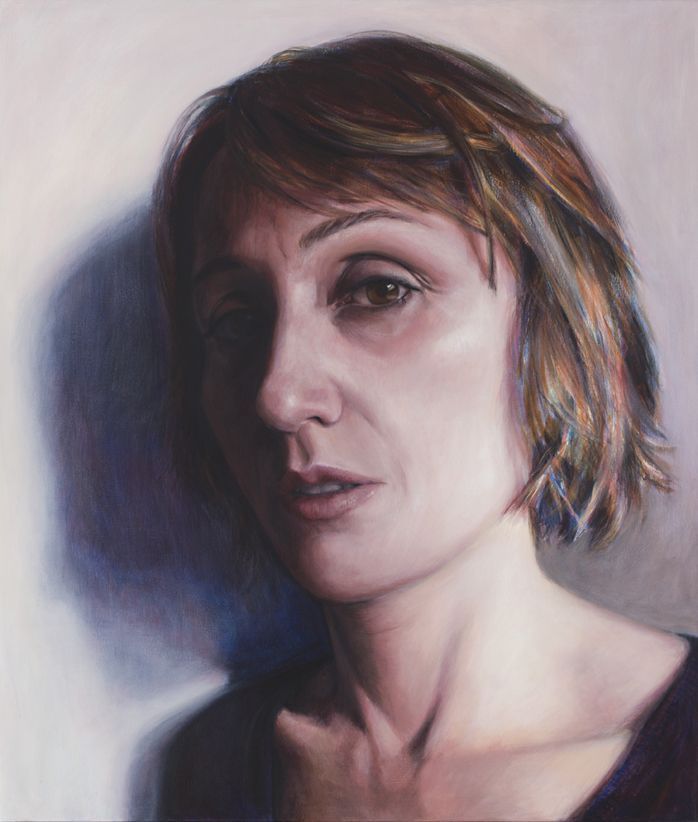
Notas sobre ‘Autorretrato’ de la exposición ‘Yo, etcétera’
Si tuviéramos que explicar la pintura a un niño pequeño, podríamos describirla como una actividad en la que usamos un palo con pelos adheridos en su extremo. Esos pelos se mojan en líquidos y pigmentos, y con esa mezcla se mancha una tela sujeta a un marco, creando imágenes.
Para el artista, pintar es el resultado de un impulso eléctrico que parte del cerebro y dirige la mano para marcar el lienzo. Los ojos comunican al cerebro la selección de colores y, casi como un acto mágico, la pintura se convierte en pensamiento hecho líquido. El lienzo, gradualmente, registra los movimientos y trazos; el resultado final captura recuerdos tanto del cuerpo como de la mente del artista.
Lo fascinante de esta práctica tan esencial y antigua es su capacidad para transformar materiales simples en imágenes que comunican emociones e ideas. El cuadro va más allá de su mera materialidad; es mucho más que la suma de sus componentes. Puede sorprender al espectador, provocando sentimientos y reflexiones.
Utilizo la pintura para comprender mejor el mundo, pero también me ayuda a conocerme, especialmente cuando trabajo en autorretratos. En la exposición Yo, etcétera, mi autorretrato te observa apenas entras a la galería; te espera.
En la mayoría de los autorretratos, la mirada suele ser penetrante y directa. Un retrato pictórico es lo más parecido a la vida real; el cuadro parece comportarse como una persona. Mirada a mirada, es la forma más genuina de reciprocidad. Con los retratos, siempre da la impresión de estar frente a frente con el modelo. En mi caso, aquí estoy, ofreciéndote mi rostro; el autorretrato me permite contemplarme sin filtros, obligándote a verme desde mis propios ojos.
Lucien Freud decía sobre el autorretrato: «Las dificultades al pintarte son psicológicas; tienes que hacerlo como si fueras otra persona». Coincido plenamente, y te muestro por qué: confieso que el ojo derecho en mi autorretrato fue complejo de pintar. Si lo miras de lado, notarás que sobresale un poco porque debajo hay muchas capas, al menos diez ojos más, todos repintados. Finalmente tuve que abordarlo como una forma abstracta, desconocida. Fue necesario observarlo desde otra perspectiva, como si fuera ajeno. Hay que eliminar prejuicios; así el autorretrato puede ayudarnos a explorar quién somos realmente.
Las reacciones de quienes han visto mi autorretrato me han enseñado bastante. «¿Por qué tienes una expresión triste?» «Parece que me miras con desprecio» «No eres así», «Te has pintado mucho mayor»… Ha sido revelador descubrir las diferencias entre lo que percibe el espectador, lo que desea ver y lo que debería ver.
Considero que para representar una versión auténtica de la vida, debemos reconocer también su faceta más oscura. Incluir el sufrimiento nos permite crear una imagen creíble de nuestra existencia. Lo que define nuestra identidad real es cómo afrontamos y respondemos a experiencias difíciles.
Hoy, en la era del selfie y las redes sociales, sentimos que debemos mostrar felicidad y salud constantemente; sin embargo, nuestra transparencia disminuye y la superficialidad aumenta. Para mí, una función crucial del arte es ofrecer una visión honesta de la vida. El arte nos ayuda a entender nuestro propio dolor y nos permite hablar de aquello que no surge en la comunicación cotidiana. Saber expresar la melancolía es tan esencial como manifestar la alegría. [Louisa Holecz]
Yo, etcetera exposición, Galería Carolina Rojo, 2014.
ENG
What would be the simplest way of describing the process of painting to a child? Perhaps we could say that it involves using a stick with a few hairs stuck to the end of it, the hairs are dipped into liquid and pigment, then this mixture is applied to a piece of cloth wrapped around a stretcher in order to make an image.
From the artist’s point of view, the process of painting is about the brain sending messages to the body that tell it how to move the paint around the canvas. The eyes tell the hands which colours to use and, as if by magic, the liquid and pigments are converted into liquid thought. Little by little, the canvas becomes a register of movements and gestures. The finished product preserves the memories of the mind and body that painted it.
What really amazes me is how this essentially primitive activity can transform these simple elements into an image capable of conveying emotions and thoughts. The painting transcends its physical reality; it is more than the sum of its parts. The final product suspends the viewer’s disbelief, it makes them feel and it makes them think.
I use the medium of painting not only to help me understand the world we live in, but also as a tool for self-knowledge. This is especially true when painting a self-portrait. My self-portrait included in the ‘I, etcetera’, exhibition looks at you as soon as you walk into the gallery; it is as if I have been waiting for you.
Most self portraits look intensely at the viewer. Painted portraits are the nearest analogy to life itself, paintings behaving like people. Eye to eye contact—a stare is the purest form of reciprocity. With portraits, there is always that sense of coming face to face with the life-model. In this case it is I confronting you. Here I am, the portrait painter, contemplating myself with no pretensions, making you see me through my own eyes.
Lucien Freud talking about self-portraits said, “The difficulties of painting yourself are psychological; you have to paint yourself as another person”. I completely agree with him and demonstrate why—I have to confess I had a really hard time painting my right eye in this portrait. In fact, if you look at that eye side-on you’ll see it is slightly raised as there are at least ten eyes painted and re-painted underneath. I had to think of that eye as if it were an abstract shape never seen before; I had to look at it from a different perspective, as if it were a stranger. All preconceptions must be erased. In this sense, a self-portrait can be thought of as an aid for the diagnosis of ‘who am I?’
I have learned a lot from viewers’ reactions to my portrait. “Why the sad face?”, “You look at me with disdain”, “It doesn’t look like you” or “You’ve made yourself look much older”. It has been an interesting experience as it has taught me a lot about the difference between what the viewers see, what the viewers want to see, and about what should be made visible to them.
I believe that in order for a realistic version of life to be represented, there must be some acknowledgement of life’s darker side; that its sufferings and sorrows deserve equal representation in order for any depiction of life to ring true. Our capacity to experience and our response to difficult experiences are what really define our self-image.
Nowadays, the age of the selfie on social networks, it seems we need to appear happy and healthy at all times. What is clear is that we are less transparent and more superficial than ever before. One of the most important functions of art is its capacity to provide a ‘reality-check’ on life.
We are therefore in need of art to help us understand our own neglected hurt, to grasp everything that does not come up in casual conversation. Knowing how to express our melancholy is just as healthy as expressing our happiness. [Louisa Holecz]
I, etcetera exhibition, Carolina Rojo Gallery, 2014.